

The best travel pillow is the one that matches how you travel. On a flight you sit upright and your head drops forward. On a train or bus you lean against the window. In a car, every turn rolls your head to one side. One pillow can handle all three, as long as it fits your neck, holds its shape and stays comfortable in Indian heat. This guide compares the main types of travel pillow, which one suits each kind of journey, how to check the fit, how to wear it properly and how to keep it clean. If you already know you want memory foam, Neodrift's travel pillows are made for flights, road trips and train journeys.
Quick answer
- Flights: a memory-foam neck pillow with enough height under the chin, worn with the thicker part where your head tends to drop.
- Trains and buses: a pillow with firm sides, so you can lean on the window without your head sliding off.
- Car passengers: the same travel pillow, with the seat belt worn properly. Drivers never wear one.
- Fit and firmness first, then fabric and how easily it packs.
- Comfort, not treatment: if neck pain keeps coming back, see a doctor.
What makes a travel pillow good?
A travel pillow has one job: hold your head comfortably while you sit and doze, so it does not fall forward or roll onto your shoulder. Four things decide whether it manages that.
- Shape. It has to support your head where it actually falls: under the chin, at the side, or both.
- Fill. The material inside decides whether the pillow still supports you after an hour, or has flattened into a soft ring.
- Fit. A pillow that is too big pushes your chin up or forward. One that is too small lets your head slip past it.
- Fabric. In a humid Indian summer, a pillow that traps heat against your neck is one you will take off within the hour.
Types of travel pillow, compared
None is perfect for everyone, but some suit long journeys far better than others.
| Type | How it feels | Best for | Watch out for |
|---|---|---|---|
| Memory foam (U-shaped) | Moulds to your neck, then slowly regains its shape | Long flights, overnight trains and buses, road trips | It takes up more bag space than an inflatable |
| Inflatable | As firm as the air you put in | Light packers and occasional short trips | Can feel sweaty against the skin and may slowly lose air |
| Microbead or fibre-filled | Soft and squishy; the filling shifts | Short naps | Flattens under the head, so support fades on long journeys |
| Wrap or scarf style | A flat support panel wrapped around the neck | People who find a U-shape bulky | Supports one side at a time |
| J-shape with chin support | Extra height under the chin and on one side | People whose head drops forward when they sleep | Needs re-wrapping when you switch sides |
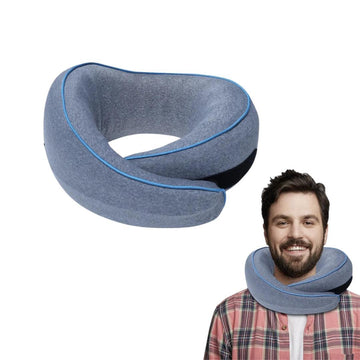
For most Indian travellers, memory foam is the practical all-rounder. It gives a little when you rest on it and then holds your head where you put it, which is what you want on a six-hour flight or an overnight bus. Neodrift's TravelNeck travel pillows are memory foam that contours to your neck. For more on how the material behaves, see our comparison of memory foam and regular neck cushions.
The best travel pillow for each kind of journey
Flights: the upright seat
Economy seats barely recline, so your head has nowhere to go but forward. That makes support under the chin the most important part of a pillow for flying.
- Recline a little if you can, so the pillow is not holding the whole weight of your head on its own.
- Window seat: turn the thicker side towards the window and lean into it.
- Aisle or middle seat: keep the support even on both sides, and keep your head off your neighbour's shoulder.
- Carry it in your hand luggage, not in a checked bag, and check your airline's cabin baggage rules before you fly.
Trains and buses: leaning on the window
In an AC chair car or a sitting coach, most people sleep leaning sideways against the window, so firm sides matter more than chin support. On an overnight bus, a firm pillow also keeps your head off the glass on bumpy stretches. On a sleeper berth, a travel pillow can double as a small pillow for a short nap.
Car passengers: road trips
A travel pillow suits passengers who want to nap, because it steadies the head through every turn and speed breaker. Keep the seat belt across the middle of the shoulder, never tucked under the pillow. Rear headrests are often low or missing in the middle seat, and a travel pillow does not depend on them at all.
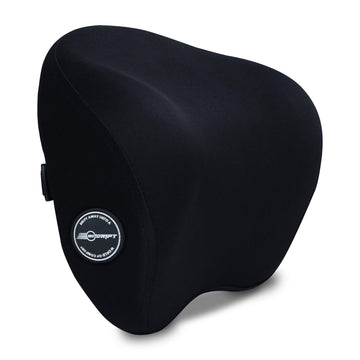
Drivers should never wear a travel pillow. It limits how far you can turn your head for mirrors and blind spots, and a pillow made for napping has no place at the wheel. A slim headrest cushion, such as the Neodrift neck cushion in memory foam with a breathable fabric, is the driver's option. Our guide to the best car neck pillow explains how to fit one against your headrest.
How to check the fit before a long journey
- Neck opening: the pillow should sit close to your neck without pressing on your throat. You should be able to swallow, talk and drink water comfortably.
- Chin clearance: the front should catch your chin when you nod, not push it up while you are awake.
- Height behind the head: on a seat with a fixed headrest, a thick back section pushes your head forward. If it does, turn the pillow round (see the tip below).
- Side height: lean to one side. Your head should land on the pillow, not fall past it to your shoulder.
- Firmness: press a thumb into the foam and let go. Good memory foam fills the dent slowly instead of springing straight back.
- Test it at home: sit upright in a chair for fifteen minutes. If it is uncomfortable there, it will not improve at 30,000 feet.
Pro tip: try it backwards
If your head keeps dropping forward on a flight, turn the pillow round so the thick back section sits under your chin and the opening is behind your neck. It is the easiest way to get chin support out of an ordinary U-shaped pillow.
How to wear a travel pillow properly
How you wear a travel pillow changes what it does.
- Opening at the front: the usual way. It supports the back and sides of your neck, and works best when you can lean back against a headrest.
- Opening at the back: the thick section goes under your chin. Use this on very upright seats if you nod forward.
- Thicker side towards the window: for leaning sideways on trains, buses and window seats.
- Low, not high: the pillow should rest on your shoulders around the base of the neck, not ride up around your ears.
- Sit right back in the seat first, then settle the pillow. Readjust it after half an hour, once the foam has warmed and settled.
Our guide to getting the most from a travel pillow has more tips for long journeys.
Fabric, heat and hygiene on Indian journeys
- Breathable fabric matters. A pillow sits against the skin of your neck for hours, and in a humid summer a fabric that traps heat soon feels sticky.
- Follow the care label. If the cover comes off, wash it as directed. Never soak or wring the memory foam itself; spot-clean it with a damp cloth and a little mild soap.
- Dry everything fully in the shade before packing it again, so no dampness is trapped inside the bag.
- Keep it out of a hot parked car. Long spells in heat and direct sun can fade the fabric, and memory foam softens as it warms.
- One pillow per person. A travel pillow touches your neck and hair, so it is not something to pass around the family. If two of you travel together, buy a pair.
- Bag it between uses. Floors at stations, bus stands and airports are not where you want the thing you will rest your face on.
Neodrift's travel pillows and cushions
The TravelNeck series is Neodrift's memory-foam travel pillow range, made for long flights, road trips and train journeys. It comes in three styles, TravelNeck, TravelNeck Pro and TravelNeck 360°, in a range of colours, and the Pro and 360° styles are also sold as a pair for two people travelling together.
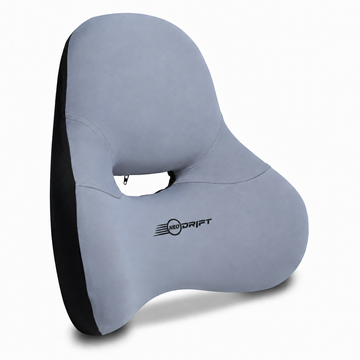
For road trips, the rest of the car matters too. The driver needs a headrest neck cushion rather than a travel pillow, and a back support cushion in memory foam with a breathable fabric and adjustable straps supports the lower back on long drives. Its cover is removable and machine washable. Our guide to choosing a back support cushion for the car explains where it should sit.
Common mistakes to avoid
- Choosing by softness alone. The softest pillow in the shop is usually the first to flatten under the weight of your head.
- Wearing it too high. A pillow around the ears pushes the head forward instead of supporting it.
- Using it at the wheel. Travel pillows are for passengers only.
- Letting it move the seat belt. The belt goes across the shoulder, with the pillow above it.
- Packing it damp. A cover that goes into a bag wet comes out smelling.
FAQs
What is the best travel pillow for flights?
A memory-foam neck pillow with good support under the chin, because economy seats barely recline and your head tends to drop forward. Wear the thicker part where your head falls: under the chin if you nod forward, at the side if you lean towards the window.
Memory foam or inflatable: which travel pillow is better?
Memory foam holds its shape better and is more comfortable over a long journey. An inflatable packs smaller, so it suits light packers on short trips, but it can feel sweaty against the skin and may lose air. For long flights and overnight trains or buses, memory foam is the better choice.
Should the opening of a travel pillow be at the front or the back?
At the front for most people, so the pillow supports the back and sides of the neck. If your head drops forward when you sleep sitting up, turn it round so the thick section sits under your chin.
Can a travel pillow help with neck pain?
A well-fitted travel pillow can make a long journey more comfortable by keeping your head in a relaxed position. It is a comfort product, not a treatment, so if neck pain keeps coming back, please see a doctor.
Pack the right pillow
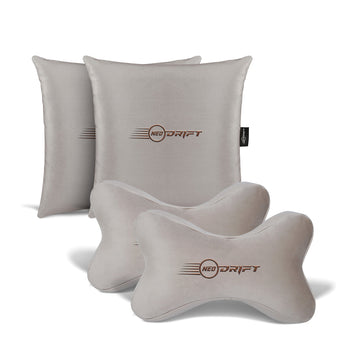
Pick the pillow for the way you travel: chin support for flights, firm sides for trains and buses, and a travel pillow for every passenger on a road trip, with a headrest cushion for the driver. Neodrift's travel pillow collection has the memory-foam TravelNeck styles, and the Neo-Kit combos pair neck and back support for the car and the office chair. For the rest of the packing list, see our essential car accessories for long road trips.
Cover photo: Pew Nguyen / Pexels