

A back support cushion for car seats fills the gap between your lower back and the backrest, so you can sit back into the seat instead of slumping towards the steering wheel. Whether one makes your drives more comfortable comes down to two things: choosing the right kind of support, and setting up your seat before you add it. This guide explains the three kinds of support (lumbar, seat and elbow), how to set the seat and cushion together, what firmness to look for and how to keep cushions clean. Neodrift's back cushions include both a lumbar back cushion and a coccyx seat cushion.
Quick answer
- Lower back feels unsupported: a lumbar back cushion in the small of your back.
- Seat base feels hard on long drives: a coccyx seat cushion on the seat itself.
- Arm tires in stop-start traffic: an elbow support cushion on the centre console.
- Seat first, cushion second: no cushion makes up for a badly adjusted seat.
- Comfort and posture, not treatment: if back pain persists, see a doctor.
Lumbar, coccyx or elbow: which support do you need?
"Back support" covers three different cushions, and each one goes in a different place.
| Type | Where it goes | Best for | Neodrift option |
|---|---|---|---|
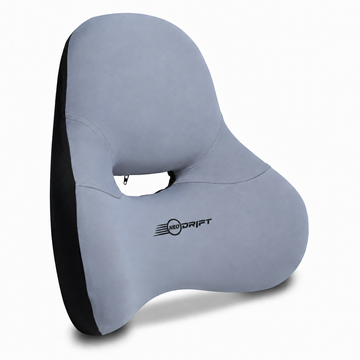
| Lumbar back cushion | On the backrest, in the small of your back | Seats with little lower-back shape, long highway drives | Back support cushion |
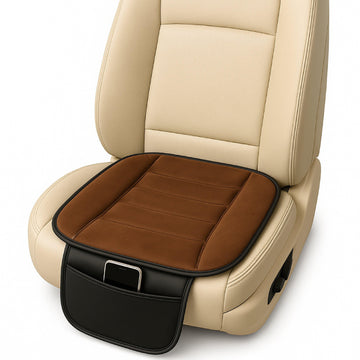
| Coccyx seat cushion | On the seat base | Long hours of sitting, firm seat bases | OrthoRest seat cushion |
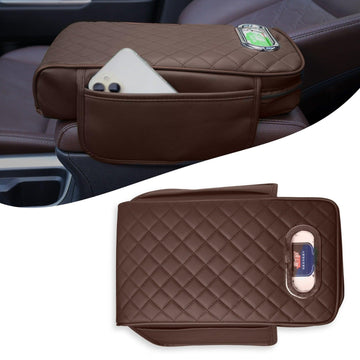
| Elbow support | On the centre console | City traffic, a relaxed arm on long drives | ArmEase |
Lumbar back cushions
Car seats are shaped for an average body. Some have very little lower-back shape, and even an adjustable lumbar setting may not sit at the right height for you. A lumbar cushion sits in the small of your back and follows its natural curve, so sitting upright takes less effort. Neodrift's back support cushion is high-density memory foam with a breathable fabric, and adjustable straps hold it to the seat so it stays in place while you drive. It suits most car seats, and an office chair too.
Coccyx seat cushions
A seat cushion goes on the seat base instead of the backrest. The Neodrift OrthoRest seat cushion is a hybrid high-density foam cushion designed for coccyx (tailbone) and back support, and its foam adapts to your shape. It suits people who sit for long hours, whether in the car or at a desk. One thing to know: any seat cushion lifts you a little higher, so re-check your mirrors, headroom and seat belt once it is in. For more options, see our round-up of car seat cushions for long drives.
Elbow support cushions
In stop-start city traffic, your left arm spends a lot of time with nowhere comfortable to rest. An elbow cushion on the centre console gives it one. The ArmEase elbow support cushion is memory foam with a breathable fabric, a non-slip base and a single-sided fastener, and it fits the centre console in most cars. The ArmEase Pro adds a built-in storage compartment. You will find both in the car armrest collection, and our guide to the best car armrest for long drives covers how to choose one.
Set up your seat first, then add the cushion
A cushion works with your seat, not instead of it. Adjust in this order:
- Sit right back so your hips touch the backrest.
- Set the seat height so you can see the road and the instruments clearly, with your hips roughly level with your knees or slightly above them.
- Set the distance so you can press the clutch or brake all the way down with a slight bend still left in your knee.
- Set the backrest slightly reclined, upright enough that you hold the wheel with your elbows gently bent.
- Add the lumbar cushion in the small of your back, around your waistline, and tighten the straps so it cannot slide down.
- Re-check everything. The cushion moves you slightly forward, so you may need to ease the seat back a notch and adjust the backrest again.
For more seat adjustments, from hip angle to headrest height, see our simple fixes for better driving comfort.
Pro tip: re-check mirrors and seat belt after any cushion
A seat cushion lifts you up and a back cushion moves you forward, so the car you set up yesterday no longer fits you in quite the same way. Before you drive off, re-set all three mirrors, check your head clears the roof, and make sure the seat belt still crosses your shoulder and sits low across your hips.
City traffic or highway: what changes
In the city, drives are short but busy: stop-start traffic, constant clutch and gear work, and long waits at signals. This is where an elbow cushion earns its place, and a lumbar cushion helps you stay sitting back in the seat instead of perching forward to watch the traffic.
On the highway, you hold one position for hours. Comfort at the seat base matters most here, so a seat cushion and a lumbar cushion together make the biggest difference, along with a break every couple of hours.
If several people drive the car, the adjustable straps on the back cushion make it easy to move it up or down for each driver. Re-check its position whenever the seat has been changed.
How firm should a back support cushion be?
Firmness decides whether a cushion feels like support or like a lump:
- Too soft: it flattens within minutes, you sink back into the old slump, and the cushion is just taking up space.
- Too firm or too thick: it pushes you away from the backrest and arches your back more than feels natural. More support is not always better.
- About right: it fills the curve of your lower back with gentle, even pressure, with no hard spots, and it still feels comfortable after an hour.
Size matters too. In a small hatchback seat, a thick cushion can push you too close to the steering wheel, so check your arm and leg reach once it is fitted. And remember that memory foam softens as it warms up: a cushion that has been sitting in a hot parked car will feel softer for the first few minutes than it does in an air-conditioned cabin.
Using cushions together on long drives
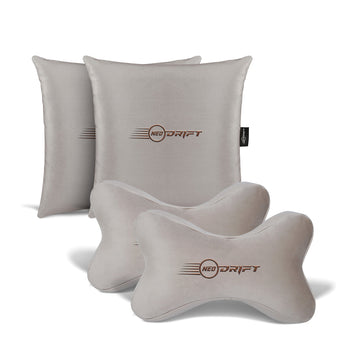
- Back and neck: a lumbar cushion pairs well with a neck cushion for the headrest. The Neo-Kit combos put the two together, and the Comfort-Kit adds the OrthoRest Pro seat cushion as well.
- One change at a time: every cushion shifts your position, so add them one by one and re-check the seat, mirrors and belt after each.
- Take them to your desk too: the back cushion and the seat cushion both suit an office chair, so one set can cover the drive and the working day.
- Take breaks every couple of hours: step out, stretch and walk for a few minutes. Our tips on staying focused during long drives cover the rest of the routine.
How to clean and care for car cushions
- Back support cushion: the cover is removable and machine washable. Do not wash the memory foam itself; spot-clean it with a damp cloth if it needs it.
- Seat cushion: follow its care label, and never soak the foam: spot-clean it with a damp cloth instead.
- Elbow cushion: wipe it down regularly, because hands and arms leave sweat and dust on it every day.
- Dry covers fully in the shade before you refit them, so no dampness gets trapped against the foam.
- Air cushions out after a long trip rather than leaving them in a closed, hot car for days, and keep them out of long spells of direct sun.
Common mistakes to avoid
- Placing the lumbar cushion too high. Halfway up your back, it pushes your shoulders forward. It belongs in the small of your back.
- Using a cushion instead of adjusting the seat. Set height, distance and recline first; the cushion is the finishing touch.
- Forgetting the height change. After adding a seat cushion, drivers often keep the old mirror settings.
- Letting a cushion slide around. Use the straps. A cushion that moves every time you brake is no support at all.
- An elbow cushion in the way of the gear lever or handbrake. Check both before your first drive.
FAQs
Does a back support cushion for car seats really help?
A well-placed back cushion can make long drives more comfortable by supporting the natural curve of your lower back and helping you sit in a better posture. It works best with a properly adjusted seat and regular breaks. If you have back pain that persists, please see a doctor rather than relying on a cushion.
Where should I place a lumbar cushion in the car?
In the small of your back, around your waistline, so it follows the inward curve of your lower back. If it feels like it is pushing your shoulders forward, it is too high; if you feel it only at the top of your hips, it is too low.
Can I use a coccyx seat cushion while driving?
Yes. The OrthoRest seat cushion is made for car seats as well as office chairs. Once it is in, re-check your mirrors, headroom and seat belt, and make sure your feet still reach the pedals comfortably.
Which is better for long drives, a back cushion or a seat cushion?
They support different areas. If your lower back feels unsupported, start with a lumbar back cushion. If the seat base is what feels uncomfortable, try a seat cushion. Many drivers use both, and a combo kit can pair them with a neck cushion.
Build a more comfortable seat
Start with the seat, then add the support you are missing: a lumbar cushion for your lower back, a seat cushion for the seat base and an elbow cushion for the console. Neodrift's back cushions include the back support cushion and the OrthoRest seat cushion, the ArmEase takes care of your elbow, and the Comfort-Kit and Neo-Kit combos bring neck and back support together.
Cover photo: Mike Bird / Pexels