

The best car neck pillow depends on who is using it. A driver needs a slim cushion that fills the gap between the neck and the headrest, without pushing the head forward or getting in the way of a shoulder check. A passenger who wants to nap needs a U-shaped travel pillow that stops the head rolling with every turn. This guide covers who should use which, how to check the fit against your car's headrest, what memory-foam firmness to look for, using it on flights and trains, and how to clean it. Neodrift's car neck cushions are made for the driver's seat and the office chair alike.
Quick answer
- Driving: a slim headrest neck cushion in the curve behind your neck. Never drive wearing a U-shaped pillow.
- Passengers who want to sleep: a U-shaped memory-foam travel pillow, which also works on flights, trains and buses.
- Children: a travel pillow only on a regular seat with the belt correctly placed, and nothing extra on a child car seat.
- Fit before softness: check your headrest's height and tilt, and choose foam that fills a dent slowly.
- Comfort, not treatment: if neck pain keeps coming back, see a doctor.
Headrest neck cushion or U-shaped travel pillow?
Both get called neck pillows, but they do different jobs.
Headrest neck cushions (for the driver)
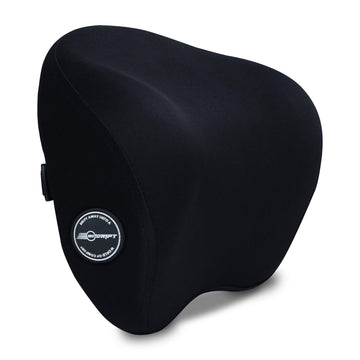
A headrest cushion sits at the base of the headrest, in the curve behind your neck, so your head can rest back in a natural position while your eyes stay level on the road. Nothing wraps around your neck, so turning to check mirrors and blind spots feels normal. The Neodrift neck cushion is memory foam with a breathable fabric, and it works on an office chair as well as a car seat.
U-shaped travel pillows (for passengers)
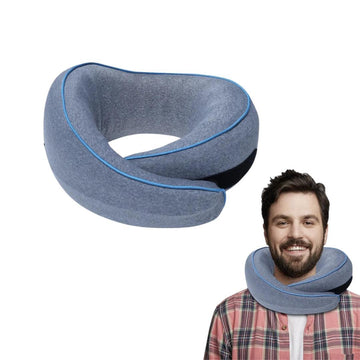
A travel pillow wraps around the neck and supports the head from the sides and under the chin, so a sleeping passenger's head does not drop sideways or forward on every turn. Neodrift's TravelNeck travel pillows are memory foam and made for the car and the plane.
| Headrest neck cushion | U-shaped travel pillow | |
|---|---|---|
| Where it sits | Between your neck and the headrest | Around your neck |
| Best for | The driver, and passengers sitting upright | Passengers who want to nap |
| Head movement | Free, with nothing around the neck | Held at the sides and chin, by design |
| Outside the car | Office chair | Flights, trains and buses |
| Watch out for | A thick cushion on a headrest that tilts forward | Too much bulk under the chin |
Driver, passenger or child: who needs which
The driver
Keep it slim and keep it behind the neck. The cushion's job is to fill a gap, not to prop your head up; if it tips your chin down or pushes your head forward, it is too thick for your seat. And never wear a U-shaped pillow at the wheel. It gets in the way when you turn your head, and a pillow that invites a nap has no place in the driver's seat.
The front passenger
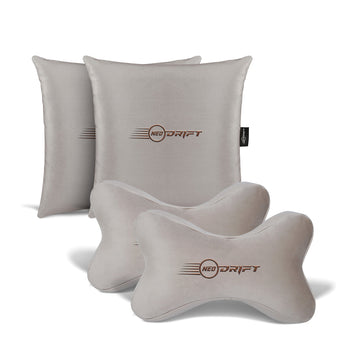
On a daytime drive, a headrest cushion is comfortable for sitting up and watching the road. For the night stretch, or whenever they want to sleep, a travel pillow is the better choice. If two people share the front seats on every trip, the neck cushions also come as a pair.
Rear-seat passengers
Rear headrests are often lower, smaller or fixed, and the middle seat may barely have one, so a headrest cushion may not sit where it should. A travel pillow does not depend on the headrest at all, which makes it the easier choice for the back seat.
Children
If your child still uses a child car seat, do not add a pillow or any padding that did not come with the seat; follow the seat maker's manual. Older children on the regular seat can use a travel pillow, as long as it does not push the seat belt off their shoulder or tip their chin down. An adult-size pillow can be bulky on a small child, so try it at home before a long trip.
How to check the fit against your car's headrest
Seats and headrests vary a lot between hatchbacks, sedans and SUVs, so check before you buy.
- Set the seat first. Sit right back, with the backrest slightly reclined and your arms slightly bent at the wheel. Ask someone to look at the gap between the back of your neck and the headrest: that gap is what the cushion should fill.
- Set the headrest height. Its top should be roughly level with the top of your head. The cushion then goes below it, at neck level, not behind your head.
- Look at the headrest angle. Many modern headrests tilt forward. On these, a thick cushion pushes your head forward, so a slimmer, contoured one fits better.
- Check for a fixed headrest. Some seats have a headrest built into the seatback that cannot be moved. Make sure a cushion can still sit where your neck is before you rely on one.
- Sit for ten minutes, not one. Your head should rest back lightly, with your eyes level on the mirrors and no need to lift or tuck your chin.
Pro tip: adjust again after 30 minutes
Seats and cushions settle once you have been sitting for a while, and so do you. After the first half hour of a long drive, take ten seconds at a stop to readjust the neck cushion. It is usually a centimetre or two lower than it should be.
Memory-foam firmness: what "just right" feels like
Memory foam shapes itself to the curve of your neck and then slowly returns to its shape, and Neodrift's neck cushions and travel pillows both use it. What matters is how firm it feels:
- Too soft: it flattens under your head within minutes, and you end up resting on the bare headrest anyway.
- Too firm: it feels like a block behind your neck and pushes your head forward.
- About right: it gives a little when you lean back, holds your head where you put it, and still feels comfortable after an hour.
A simple test: press a thumb into the foam and let go. Good memory foam fills the dent slowly rather than springing back at once. Memory foam also softens as it warms up, so a pillow that feels firm in an air-conditioned cabin can feel softer after a few hours in a hot parked car. For more on materials, see our comparison of memory foam and regular neck cushions.
Is the best travel pillow for flights good in the car too?
Yes, for passengers. The U-shaped pillow people look for as the best travel pillow for flights does the same job on a road trip, a train journey or an overnight bus.
- On a flight: wear it with the thicker part where your head tends to drop: under the chin if you nod forward, at the side if you lean towards the window. Recline a little so the pillow is not holding your head up on its own.
- On a train: in a sitting coach it works just as it does in a car, and on a sleeper berth it can double as a small pillow for a short nap.
- On a bus: a window seat suits it best, because the pillow keeps your head off the glass on bumpy stretches.
Neodrift's travel pillows are made for the car and the plane, and our guide to getting the most from a travel pillow has more tips for long journeys.
Long drives: comfort habits that help
- Take breaks every couple of hours: stand up, stretch and walk around for a few minutes. Our tips on staying focused on long drives cover the rest of that routine.
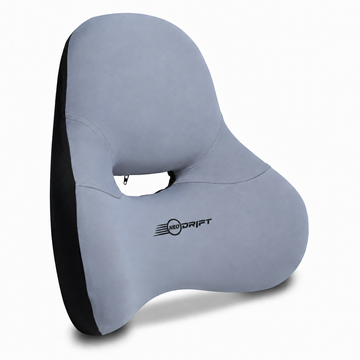
- Support your lower back too. A back support cushion in the small of your back helps you keep the whole seated position comfortable.
- Seat belts on for everyone who sleeps, and a pillow for each passenger on overnight trips. For the full packing list, see our essential car accessories for long road trips.
How to clean a car neck pillow
- Wash the cover, not the foam. Follow the care label, and if the cover comes off, wash it as directed. Never soak or wring the memory foam itself; spot-clean it with a damp cloth and a little mild soap.
- Dry everything fully in the shade before the cover goes back on, so no dampness is trapped inside.
- Air it out after a long trip instead of leaving it in a closed, hot car, and keep it out of long spells of direct sun, which can fade and harden the fabric.
- Replace it when the foam no longer springs back into shape.
Common mistakes to avoid
- Placing the cushion behind the head. It pushes your head forward; it belongs behind the neck.
- Skipping seat adjustment. No cushion can make up for a seat that is too far back or too upright.
- Leaning on the window to sleep. A travel pillow is more comfortable and keeps the head steadier.
- Never washing the cover. It turns uncomfortable and unhygienic in hot, humid weather.
FAQs
Which is the best car neck pillow for drivers?
A slim headrest neck cushion. It supports the curve of your neck in a natural driving position and leaves your head free to turn for mirrors and blind spots, which a U-shaped travel pillow does not.
Can a neck pillow help on long drives?
A well-fitted neck cushion can make long drives more comfortable by supporting your neck in a relaxed position, alongside a properly adjusted seat and regular breaks. If you have persistent neck pain, please see a doctor rather than relying on a cushion.
Are travel pillows good for car passengers?
Yes. A U-shaped travel pillow supports a passenger's head from the sides, so it does not roll with every turn while they rest or sleep. Keep the seat belt on at all times.
Can I use the same travel pillow on a flight?
Yes. A U-shaped travel pillow works the same way on a flight, a train or a bus as it does in a car. Wear the thicker part where your head tends to drop, and carry it in your hand luggage.
Travel more comfortably
Drivers: choose a slim headrest cushion and fit it behind your neck. Passengers: pack a travel pillow for the car, the train and the plane. Neodrift's car neck cushion collection has the neck cushion for the driver's seat and the Neo-Kit combos that pair neck and back support, and the TravelNeck travel pillow is there for everyone else.
Cover photo: Luke Miller / Pexels