

If you have ever wondered how to put car cover on without leaving fine scratches, or which end of it is the front, you are not alone. A cover only protects the paint if it goes on and comes off the right way: over a clean, dry, cool car, anchored at the mirrors first, and lifted off rather than dragged. This guide covers the whole routine, including windy days, a one-person method for tall SUVs and the times you should not cover the car at all. If you still need a cover made for your model, start with Neodrift's car covers.
Quick answer
- Cover only a clean, dry, cool car — never straight after a drive or a wash.
- Tags inside, Front tag to the front.
- Mirrors first, then the front bumper, then over the roof to the rear bumper.
- On windy days, tie it down with the buckle belt (SuperTech) or a rope through the grommet holes (other tiers).
- To take it off, release both bumpers, fold the sides onto the roof, then fold it from front to back.
Before you start: when not to cover your car
Most scratches blamed on car covers come from what was on the car when the cover went on. The rule is simple: cover only a clean, dry, cool car. Here is when to hold off, including the don'ts in Neodrift's own fitting instructions (the "Fitting Instructions & Care Guide" link on its car cover pages):
| Don't cover it when… | Why | Do this instead |
|---|---|---|
| The car is dusty or has bird droppings | Dust is fine sand, and under a cover that shifts it acts like sandpaper. Droppings can etch the paint. | Rinse it, or mist the panels and lift the dust with a clean microfiber cloth. Never dry-wipe. |
| The car is wet from rain or a wash | Water sits against the paint for longer and the cover stays damp | Let it dry, or dry it with a microfiber cloth |
| You have just parked | The tail pipe and bonnet are still hot, and heat from the exhaust can damage the fabric | Wait until the car has cooled down |
| A window or the sunroof is open | It is on the fitting instructions' list of don'ts | Close everything first |
| The paint is freshly repaired | New paint needs time to cure | Ask your paint shop when it is safe to cover |
A lightly dusty car doesn't need a full wash every evening; the rinse or mist-and-lift is enough. Our guide to choosing the right microfiber cloth explains which cloth to use where, and here is how to remove bird droppings from car paint safely.
How to put car cover on: the mirrors-first method
The order below follows Neodrift's fitting instructions, with the reason behind each step.
1. Find the Front tag
Every Neodrift cover has a "Front" and a "Rear" tag sewn in. Find the Front tag before you unfold anything, and check that the tags are on the inside. A cover that goes on inside-out puts its outer face against the paint, which the instructions warn can damage it.
2. Unfold it on the car, never on the ground
Set the folded cover on the roof with the Front tag facing the bonnet. Unfold the front half over the windscreen and bonnet, and leave the back half folded on the roof for now. The ground is where the grit is, so keep the cover off it.
3. Mirrors first
Open out the sides and fit the cover over both side mirrors. Most people skip this step, yet it matters most. With both mirrors in, the cover is centred and anchored, so it can't slide off the roof while you walk around the car.
4. Front bumper next
Draw the cover down over the headlights and secure the hem under the front bumper.
5. Over the roof, and the rear bumper last
Unfold the back half over the roof, rear glass and boot, lifting it back in sections rather than sliding it across the paint. Cars with a big antenna get a separate antenna pocket on their Neodrift cover, so line it up on the way (a small antenna needs none, because the cover is sized for it). Finish by hooking the hem under the rear bumper.
6. Walk round and settle it
Pull the side panels straight down and check that both hems sit evenly. A lopsided cover has usually gone on back to front or missed a mirror, so go back to step 3 rather than tugging at the hem.
Getting the hem right
- Use both hands. Spread it wide, place it under the bumper and let it settle. Hauling one corner round strains the fabric and the stitching.
- Tuck it under, not just round. A hem under the bumper lip stays put; one that only reaches the face of the bumper rides up in the first gust.
- Release it by hand. Unhook the hem before you take the cover off, so it isn't dragged over the bumper corners.
Covering your car on a windy day
Wind turns a loose cover into a sail, and a cover that flaps all night rubs the same panels again and again. Four habits keep it in place:
- Keep it folded until it is on the roof. Never shake it open like a bedsheet.
- Stand on the side the wind is coming from and let the cover open away from you, so the wind presses it onto the car instead of getting under it.
- Get the mirrors in straight away. Once both are in, a gust can't carry the cover off.
- Tie it down. SuperTech covers come with a buckle belt. The other tiers have grommet holes: pass a rope under the car and tie both sides tightly.
If your car lives in an open, windy spot, tie it down every day, not only on stormy nights.
One-person method for SUVs and tall cars
On a Toyota Innova Crysta, Mahindra XUV700 or Toyota Fortuner, the middle of the roof is out of reach, so people throw the cover over the top and then drag it straight. You can do it alone without either:
- Use a small, sturdy step stool beside the front door. It is safer than standing on the door sill, a tyre or the bumper.
- Start at the windscreen. Rest the folded cover on the bonnet with the Front tag facing forward, and push the folded back half up onto the roof.
- Anchor the mirrors, then the front bumper. Now the cover can't slide down while you move the stool.
- Unfold the back half from the side, working from the stool, then draw it down over the rear glass and hook the rear hem.
To take it off alone, reverse the routine: release both hems, fold each side up onto the roof from the stool, then fold the strip from front to back. Neodrift tailors its covers model by model, such as the Toyota Innova Crysta car cover and the Mahindra XUV700 car cover. They are made for the standard model, so if your SUV carries a roof carrier or another add-on, check the fit with the team on WhatsApp before you order.
How to remove a car cover without dragging dust over the paint
By evening the outside of the cover is dusty, which means it has done its job. Now get it off without that dust touching the paint:
- Release both ends. Unhook the hem from under the rear and front bumpers.
- Fold each side up onto the roof. Lift one side panel onto the roof, then the other, so the cover becomes a long strip along the top. Lifting takes the fabric straight off the paint instead of sliding it across.
- Fold from the front to the back. Fold the strip in three towards the back, then lift the bundle away.
As the sides go up, the dusty outer face folds in on itself, so the dust stays inside the bundle and the clean side meets the paint next time. Never grab the cover at the back and pull it off in one sweep. Any grit that crept under the edges gets dragged across the roof and boot, and the cover lands on the ground. For neat folding and storage, see our guide on how to fold a car cover, and let a rain-wet cover dry before you pack it away.
Pro tip: let it breathe every two days
Neodrift's fitting instructions advise against leaving a car covered and parked in rain, sun or dust for more than 48 hours at a stretch. If the car is standing for a week, because you are travelling or it only comes out at weekends, take the cover off every couple of days, let the car and the cover air out for a while, and put it back.
Common mistakes to avoid
- Covering a dusty car "just for tonight". One night of a cover shifting over grit can leave fine marks.
- Throwing it over the roof. It lands crooked, and straightening it means dragging it.
- Letting it touch the ground. If it does, shake it out before it goes back on.
- Skipping the rope or belt on a windy night. The flapping does the damage.
FAQs
Do car covers cause scratches?
Not when they are used properly. Scratches come from grit trapped under the cover, a loose cover flapping in the wind, or a cover dragged on and off. A clean car, a fitted cover and the lift-don't-drag routine avoid all three. Our guide on whether car covers damage paint goes deeper.
Should I put a car cover on every day?
If your car is parked outside, yes; daily use is what a cover is for. Just keep to the clean, dry and cool rule each time.
Which side of the car cover goes on the car?
The side with the tags goes against the car, and the Front tag goes to the front. If the cover won't sit over both mirrors, it is probably back to front.
Is it okay to leave the cover on in the rain?
Yes, as long as the car was dry when you covered it. Neodrift covers are water-resistant and handle light to moderate rain well. In very heavy rain a little water can seep through, and it dries off quickly. After a long wet spell, lift the cover once the weather clears so the car and the cover can dry out. Our monsoon car care tips cover the rest of the season.
Pick a cover that fits your car
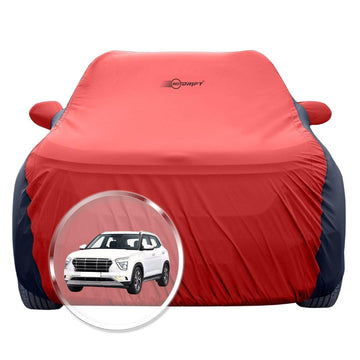
Every step above is easier with a cover made for your car: it sits over the mirrors where it should, the hems reach under both bumpers, and there is less loose fabric for the wind to catch. Neodrift makes its covers model by model, so pick your exact model year when you order (if no year is shown, the cover fits all variants). Browse all Neodrift car covers, or go straight to popular fits like the Hyundai Creta car cover and the Maruti Suzuki Swift car cover. Not sure which tier suits where you park? Our guide on which material suits a car cover will help you choose.
Cover photo: Efrem Efre / Pexels