

An electric scooter cover does the same basic job as any scooty cover, keeping off sun, dust, rain and bird droppings, but an EV changes how you use it. There is no hot silencer, so you can cover it the minute you park. There is a battery and a charger involved, so you need a rule for charging time. And the parts that worry most owners, the battery and the electronics, are already sealed to a published standard, so the cover's real job is the body, the seat and the screen. This guide explains how to choose and use a cover for the Ola S1, Ather 450X, Ather Rizta and TVS iQube. Neodrift's Ola electric scooter covers and Ather scooter covers are listed model by model.
Quick answer
- Pick the page for your exact model and generation. The Ola S1 Pro and S1 Pro Gen 2 have separate listings, and so do the Ather 450 and 450X.
- Cover it as soon as you park. An EV has no exhaust to melt the fabric.
- Take the cover off before you charge. Charging warms the battery and the charger; let that heat escape and keep the plug in sight.
- Water-resistant, and that is enough. The cover sheds light to moderate rain. The battery's own rating, not the cover, is what protects the cells.
- Tell the team about add-ons such as a top box, crash guard or seat-back before you order.
What is different about covering an electric scooter
Most advice about scooty covers is written for petrol scooters. Three things change when the scooter is electric.
1. No exhaust, so no waiting
On a petrol scooter you should wait for the silencer to cool before the cover goes on, or the fabric can scorch or melt against it. An electric scooter has no exhaust at all. That removes the most common reason people skip the cover after a ride: they park, mean to come back in ten minutes, and never do. With an EV you can cover it straight away.
2. Charging time is cover-off time
Many owners charge overnight in the same spot where the scooter is covered. Take the cover off, or at least fold it well clear of the charging point and the charger, before you plug in. A battery and charger give off warmth while charging, and a fabric layer draped over them traps it. It also hides the charger, so you cannot see a loose plug, a wet socket or a cable pulled tight across the floor. Put the cover back on once charging is finished and the cable is stowed.
3. The battery is sealed; the body is not
This is the part most buyers get wrong. Electric scooter battery packs carry an IP (ingress protection) rating. Ola, for example, lists the S1 Pro's battery pack as IP67. Under the IP standard, the first digit 6 means dust-tight, and the second digit 7 means the enclosure survives temporary immersion, tested at up to 1 metre of water for 30 minutes. So the cells inside are not what a cover is protecting.
Two details matter, though. First, the rating belongs to the battery pack, not the whole scooter: spec listings for the same Ola S1 Pro put its controller at IP65, which means protected against water jets rather than immersion. Second, an IP rating says nothing about sun-faded panels, a cracked seat, a dashboard screen baking in the afternoon, or bird droppings eating into paint. That is the cover's job. To find your own scooter's ratings, look in the owner's manual or the manufacturer's specification page; the figures differ from model to model.
What a cover actually protects on an EV
| Part | What hurts it when parked | Does a cover help? |
|---|---|---|
| Painted body panels | Sun fade, dust wiped off dry, bird droppings, scratches from passers-by | Yes, this is the main job |
| Seat | Heat and sun dry out the cover; rain soaks into any crack | Yes |
| Dashboard screen and switches | Direct afternoon sun, dust in the switch gaps | Yes, keeps it shaded and clean |
| Battery pack | Heat over long periods; deep standing water | Only a little: shade from the cover helps, but parking out of the sun helps far more, and no cover stops flood water |
| Charging socket | Dust and rain around the flap | Yes when parked, but uncover it before charging |
Neodrift bike covers are made from multi-layer fabric that is UV-resistant, water-resistant and breathable, and the listings describe them as protecting against rain, dust and scratches. Breathable matters on any two-wheeler: moisture that gets under the cover can escape instead of sitting on metal parts. Our explainer on whether bike covers really protect from rust goes deeper into why.
How to choose the right cover for your electric scooter
Match the exact model and generation
Electric scooters change shape between generations more than you might expect, and the body is wider and flatter than many petrol scooters. Neodrift lists each model on its own page, so pick the one that matches what is written on your registration certificate:
- Ola: S1, S1 Air, S1 Pro, S1 Pro Gen 2, S1 X, S1 X Gen 2, plus the Ola Roadster range. The cover for the Ola S1 Pro is a separate page from the Gen 2 one.
- Ather: the cover for the Ather 450X, a separate one for the Ather 450, and the cover for the Ather Rizta, which is a larger family scooter.
- TVS: the cover for the TVS iQube sits in the TVS bike covers collection.
If your scooter is not listed, the covers are made in three sizes (Medium, Large and X-Large), and the team can tell you which one suits it.
Account for add-ons
The covers are designed for standard, stock scooters. A top box, a rear seat-back for a passenger, a crash guard or a phone mount changes the outline. If your scooter has any of these, message Neodrift on WhatsApp before ordering so the team can advise on fit. If you are measuring yourself, take the length, height and width with the add-ons fitted.
Pick the tier by where it parks
Neodrift sells bike covers in tiers, from SuperMax at the top through NeoMax and CrystalMax to JungleMax. The listing's own guidance is simple: how long a cover lasts depends on the tier and the weather it faces, and the higher tiers hold up better in harsh conditions. A practical way to decide:
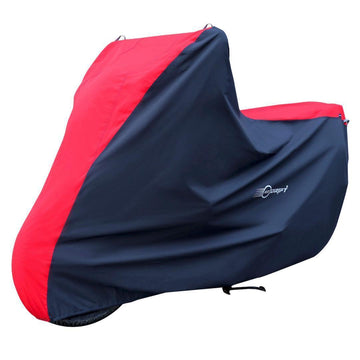
- Open society lot or roadside, full sun and rain: go for a higher tier. This is where a cover works hardest.
- Covered basement or stilt parking: dust is the main enemy, and a lower tier usually does the job.
- Office parking in the day, home at night: think about the worse of the two spots, since that decides how fast the fabric ages.
Use the lock
The listings include a lock feature. Use it in open parking: a cover blown off by the wind in the night protects nothing, and a locked cover is also less tempting to borrow. Our guide on protecting a bike parked outside covers the rest of the outdoor routine.
A daily routine that takes under a minute
- Park and switch off. If you will charge tonight, plug in first and leave the cover off.
- Front first. Hook the cover over the handlebar and mirrors, then pull it back over the seat and tail.
- Tuck the hem under the floorboard and rear so wind cannot get underneath.
- Lock it if you are parked in the open.
- In the morning, fold it from the front back so the dusty outer side stays on the outside, and keep it in a dry spot, not damp in the under-seat storage.
Pro tip: before the monsoon, open your owner's manual and note the battery's IP rating and the maximum water depth the manufacturer allows riding through. Write it on the inside of the under-seat flap. A cover handles rain on a parked scooter; that number is what you need on a flooded road.
Rain, flooding and the limits of a cover
A water-resistant cover is built for light to moderate rain and slows seepage in heavy rain. Some water can still pass through in a downpour; because the fabric is breathable, it evaporates rather than staying trapped. That is fine for a sealed battery pack and a scooter body, which are designed to cope with wet roads.
What no cover can do is protect against standing water. If your parking floods, move the scooter to higher ground; a cover will not keep rising water away from the motor, the controller or the battery. If an electric scooter has been sitting in deep water, have it checked at an authorised service centre before you ride or charge it. For what rain does to the rest of a two-wheeler, see is it okay for a motorcycle to get rained on, and after a wet spell, our guide to cleaning electrical contacts after rain.
Common mistakes to avoid
- Charging under the cover. It traps warmth and hides the charger. Uncover first.
- Buying by brand instead of by model. An Ather 450X and an Ather Rizta are very different shapes, and so are Ola's first and second generation scooters.
- Treating the battery's IP67 as a whole-scooter rating. It applies to the pack. Other parts carry their own, usually lower, ratings.
- Covering a wet, muddy scooter. Grit under the fabric scratches the panels every time the cover moves. Wipe off the worst of it first; our guide on which GSM microfiber cloth to use applies to scooters too.
- Folding the cover away wet. Let it dry spread out before you pack it.
- Leaving it loose in the wind. Tuck the hem and use the lock.
FAQs
Do electric scooters need a cover if the battery is IP67?
Yes, if the scooter is parked outside. The IP67 rating protects the cells inside the battery pack. It does nothing for sun-faded panels, the seat, the dashboard screen or bird droppings, which is where a parked scooter actually ages.
Can I charge my electric scooter with the cover on?
We recommend you don't. Take the cover off before plugging in so the battery and charger can shed heat and you can see the plug, then cover it again once charging is done.
Can I put the cover on straight after a ride?
Yes. Unlike a petrol scooter, an electric scooter has no hot exhaust that could damage the fabric.
Will an electric scooter cover keep out all rain?
Not every drop. Neodrift covers are water-resistant: they handle light to moderate rain and reduce seepage in heavy rain, and the breathable fabric lets trapped moisture dry out.
My electric scooter is not listed. What should I do?
The covers come in Medium, Large and X-Large. Message the team on WhatsApp with your model and any add-ons and they will suggest the size.
Find the cover for your electric scooter
Start from your model: Ola covers, Ather covers or the full bike and scooty cover range. If you also own a petrol scooter, our scooty cover guide covers the Honda Activa, TVS Jupiter, Suzuki Access and TVS Ntorq.
Cover photo: panumas nikhomkhai / Pexels